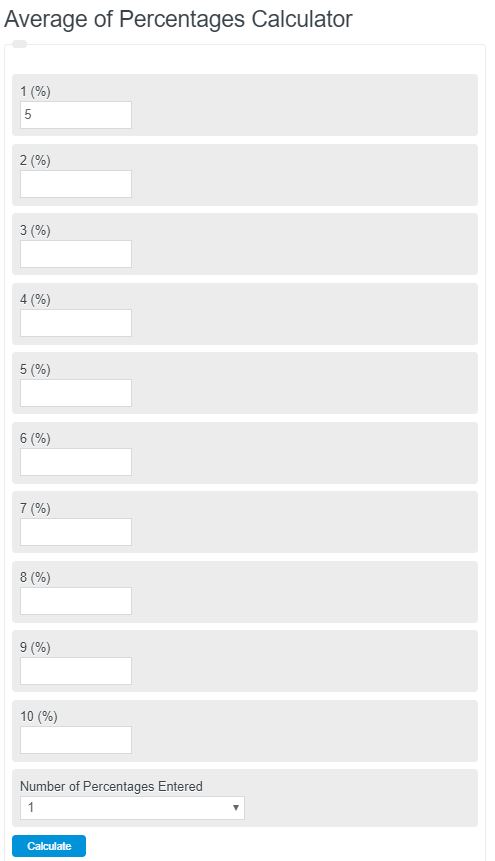
Calculate the simple or weighted average of multiple percentages, add or remove entries, apply sample-size weights, and review sums, counts, and ranges.
Average of Percentages Formula
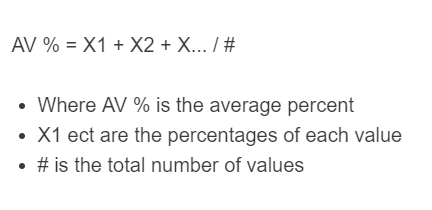
The following formula is used to calculate the average of a group of percentages.
- Where AV is the average percent
- X1..etc are the percentages of each value
- N is the total number of values
Average of Percentages Definition
The average of percentages is the true average of a set of two or more percentage values.
Average of Percentages Example
Example Problem #1:
First, gather all of the percentages together. For this example, the percentages are 10%, 25%, 12%, and 3%.
Next, sum all of the percentages together. Adding the values from above together yields:
= 10 + 25 + 12 + 3 = 50%.
Next, determine the total number of percentages. For this example, there were 4 percentages added together.
Finally, calculate the average of the percentages using the formula above:
AV % = X1 + X2 + X... / #
AV % = 50%/ 4
AV % = 12.5%
FAQ
A percentage is a ratio of a number to a total of 100%. For example, 1 out of 10 would be 10%.
How to calculate the average of percentages
- First, sum all of the percentages together
Add all of the percentages together to get one value. For example, if you had 1%, 2%, and 3%, the sum would be 6%.
- Next, count the number of values
This is the total number of values. In the example above, this number would be 3, since there are 3 separate percentages.
- Calculate the average
Enter the information into the equation above to determine the average.