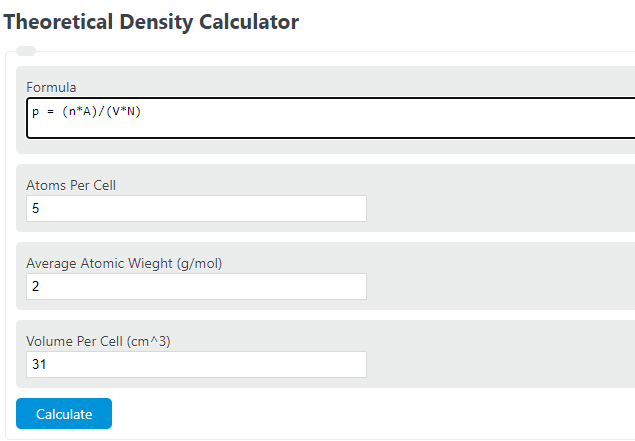
Calculate theoretical density for crystal unit cells, alloy mixtures, or mass and volume values, with unit conversions and formulas.
Customize This Calculator
Build your own version. Describe what you want changed, added, or compared.
Theoretical Density Formula
The formula for calculating the theoretical density is as follows:
- Where ρ is the density (g/cm^3)
- n is the number of atoms per unit cell (for elemental crystals). For compounds, use Z = number of formula units per unit cell.
- A is the atomic weight / molar mass (g/mol) of the element (for compounds, use the molar mass of the formula unit).
- V is the unit-cell volume (cm^3/cell). If your volume is in Å^3, convert using 1 Å^3 = 10^-24 cm^3.
- NA is Avogadro’s constant (6.02214076×10^23 mol^-1).
To calculate a theoretical density, multiply the number of atoms per unit cell by the molar mass, then divide by the product of the unit-cell volume (in cm^3) and Avogadro’s constant. (This page’s calculator accepts unit-cell volume in Å^3 and applies the 10^-24 cm^3/Å^3 conversion automatically.)
Theoretical Density Definition
Theoretical density is the density calculated from a material’s crystal structure and molar mass assuming an ideal, fully dense crystal (no porosity) at the specified lattice parameters.
What is the theoretical maximum density?
The theoretical density of a crystalline material can be calculated using ρ = (n*A)/(V*NA) (or ρ = (Z*M)/(V*NA) for compounds). It represents the ideal crystal density for the given crystal structure and lattice parameters; real (measured) bulk density is often lower due to porosity, impurities, and defects.
How to calculate a theoretical density?
- First, determine the number of atoms per unit cell (elements) or the number of formula units per unit cell (compounds).
- Next, determine the molar mass: use the atomic weight for an element, or the molar mass of the formula unit for a compound/alloy.
- Next, determine the unit-cell volume from the lattice parameters. Unit-cell volumes are typically on the order of tens to hundreds of Å^3 (about 10^-23 to 10^-21 cm^3), not 1 cm^3 per cell.
- Finally, calculate the theoretical density. Using the formula along with Avogadro’s constant, you can calculate the theoretical density.